A field journal that paints itself in.
Exsiccatae — a herbarium of everything you've seen.
Photograph a bird — or listen for its song — and Exsiccatae names it entirely on your phone, then mounts it on the page like a pressed specimen. See a species once and it's a graphite ghost; see it again and again and it fills with watercolour.
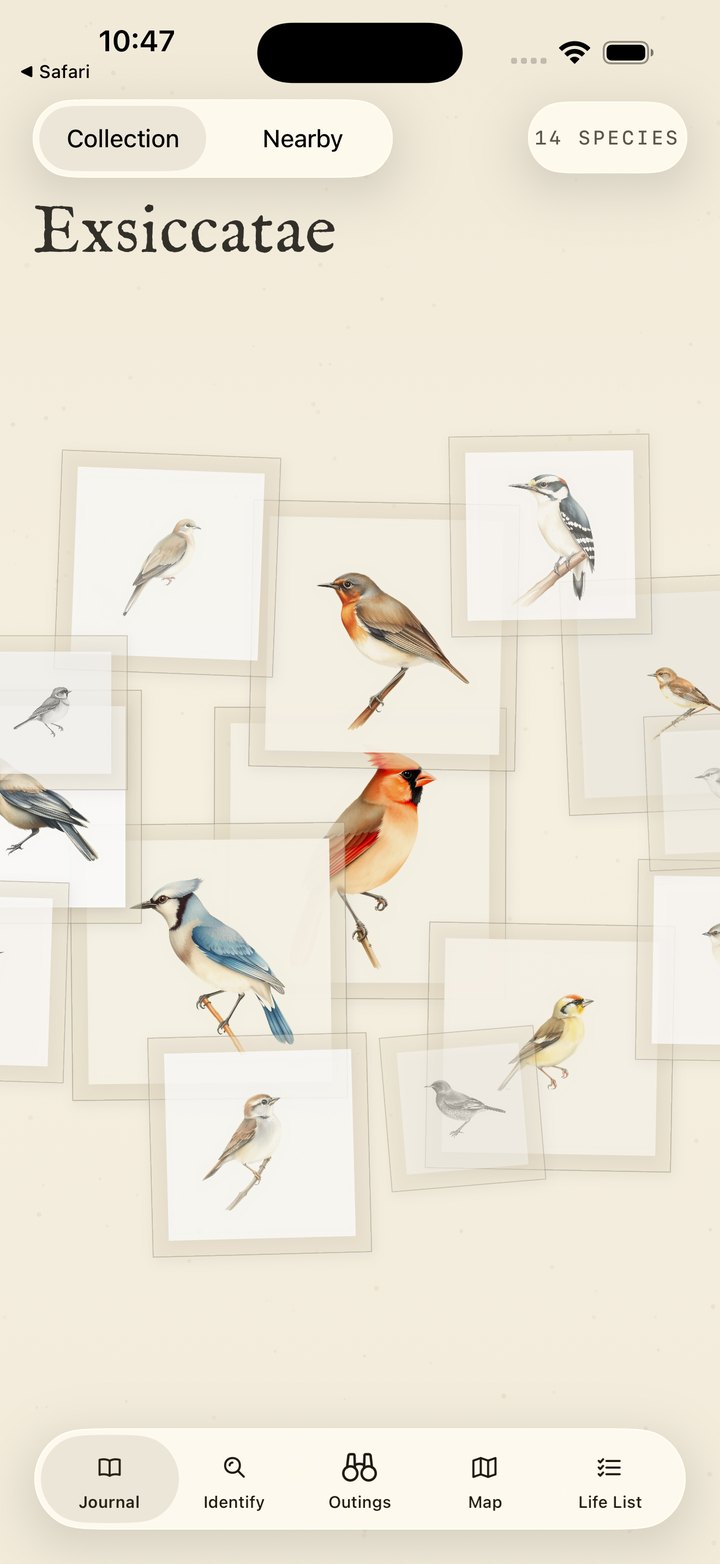
Every bird you meet, pressed and kept.
Five ways Exsiccatae turns a walk into a collection — all on your phone.
Named on your device
A photo is identified by an on-device model that reranks by what's plausibly nearby. A continuous listening session picks out birdsong from the microphone in real time — and the birds it hears settle onto the page as you listen. Nothing is uploaded; it works offline.
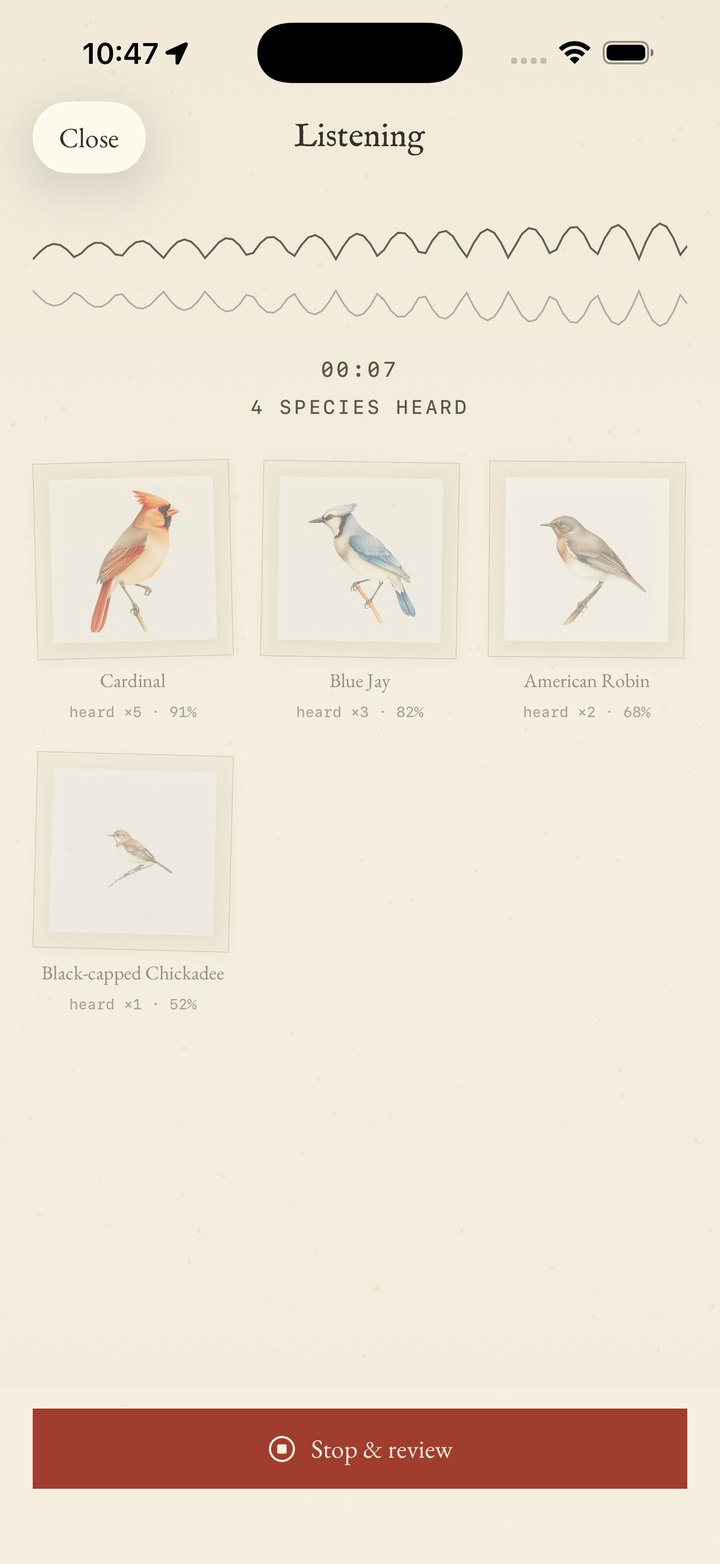
It paints itself in
First sighting: a pencil underdrawing. By the fourth: a full watercolour plate. The living collage grows with your collection and rewards return — the birds you know best glow brightest. Pinch to lean in over the sheet.
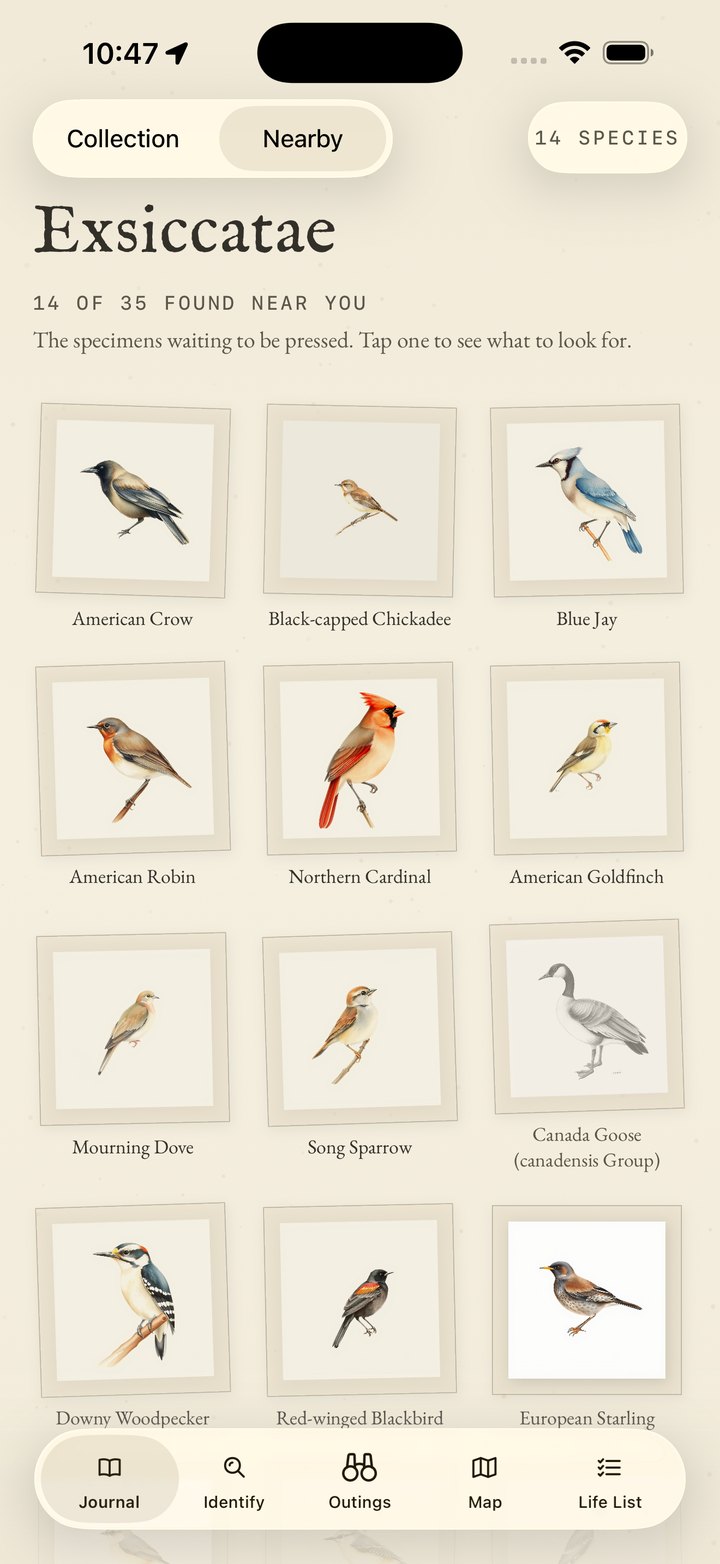
Expected nearby
See the species actually recorded around you as pencil-ghost plates — the specimens waiting to be found. Each resolves into full watercolour the moment you press it into your journal.
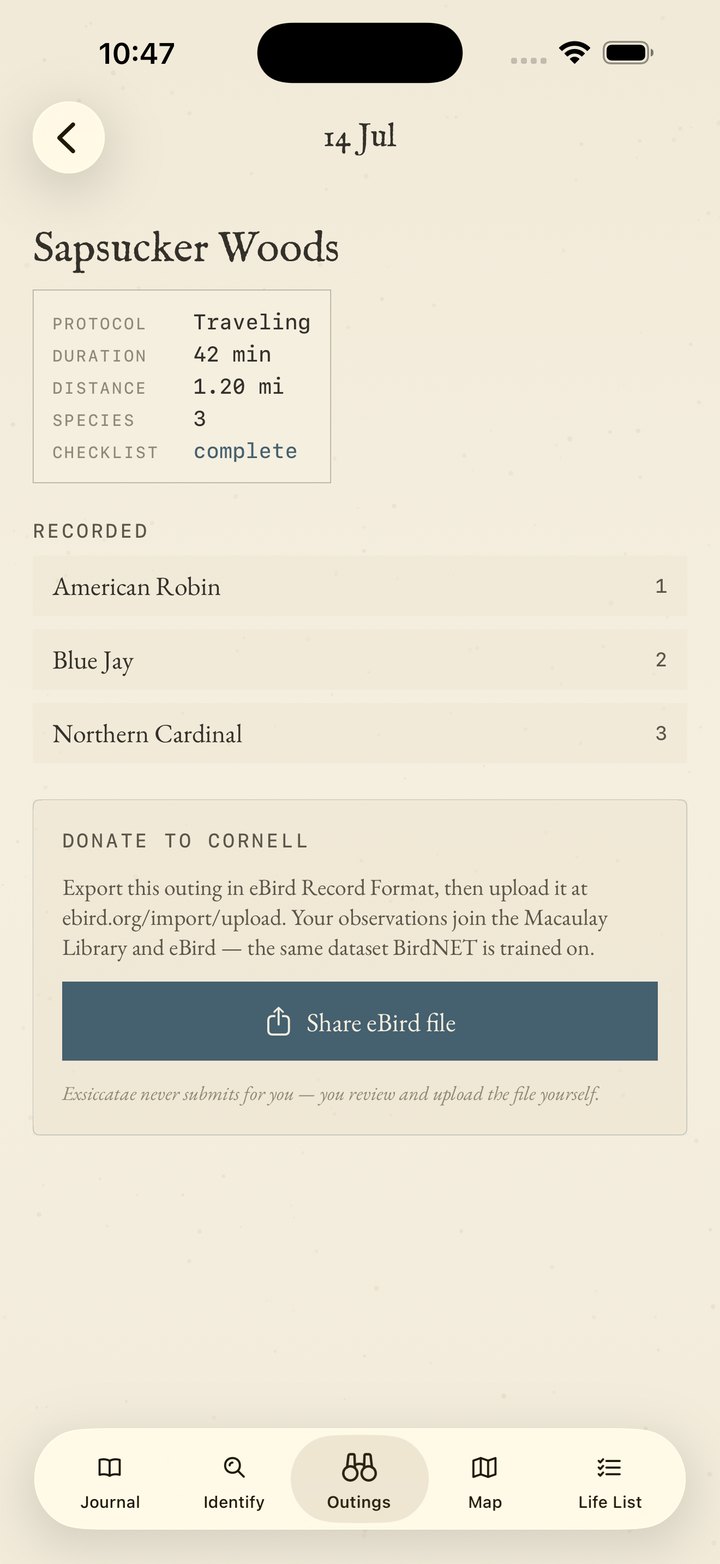
Real outings, real method
Start a timed, located outing — stationary, traveling, or incidental — matching eBird's own protocols, with optional GPS distance for walking counts. Then donate it: export the outing in eBird Record Format and upload it yourself to the Cornell Lab of Ornithology.
A collection you keep
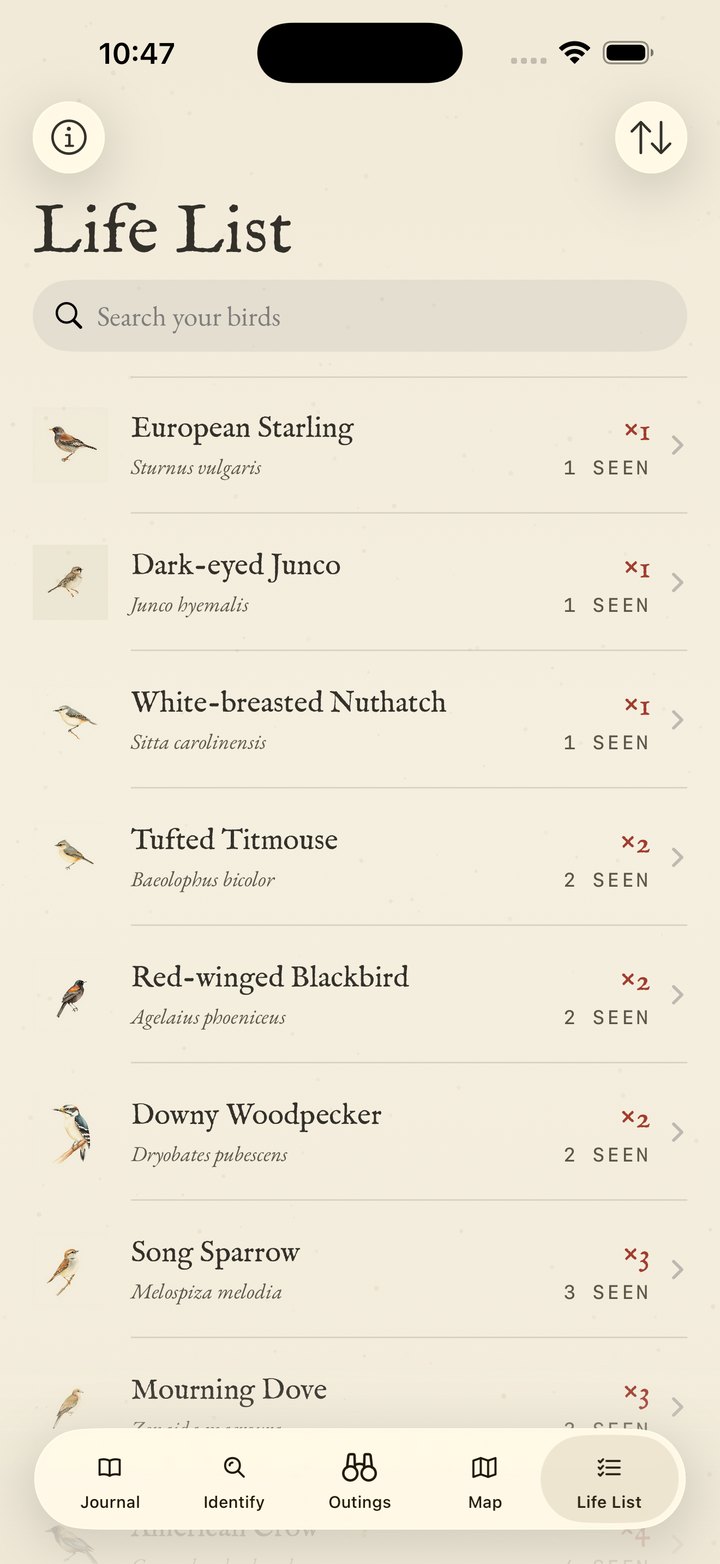
Every species joins your life list, searchable and sortable, each a specimen row with its own watercolour. Correct a finding, attach your own photos and recordings, or share a bird as a pressed specimen card.
Your walk can feed real science.
Exsiccatae speaks eBird. Any outing exports as a standard eBird checklist you upload yourself to the Cornell Lab of Ornithology — joining the Macaulay Library and eBird, the same dataset that trains birdsong models. You always review it first; the app never submits on your behalf.
Protocols that count
Stationary point counts, traveling transects, and incidental notes — with duration, distance, and complete-checklist flags real ornithology needs.
Locations with humility
A bird's position is estimated from your bearing and distance, carried with a genuine uncertainty circle — never a false pinpoint.
Standing on GBIF
Names, taxonomy, and “expected nearby” come from the Global Biodiversity Information Facility, cached and attributed.
Local-first, by design
Photos and audio are identified entirely on your device and never uploaded. Your sightings, locations, recordings, life list, and journal live only on your iPhone — no account, no cloud copy. The only things that leave the phone are anonymous name look-ups and a coarse (≈11 km) location for “expected nearby.” No tracking, no analytics, no ads. Read the privacy policy →
A portfolio project, built solo end to end. A native SwiftUI + SwiftData app; on-device Core ML for both photo and birdsong identification (the audio model runs BirdNET converted to Core ML by replacing its FFT front-end with an equivalent cosine matmul); a pure-Swift domain core with a real test suite — the geodesy, taxonomy, and the frequency-weighted collage algorithm; and a single dependency-free Cloudflare Worker + D1 + R2 backend serving a cached, attributed GBIF facade and generating the watercolour plates. This page is a lens on that work.